Soft Goods: Drops, Legs, Borders, Masking

Soft Goods
Drapes, Curtains, Backdrops, Cycloramas, Fabric, Sewing
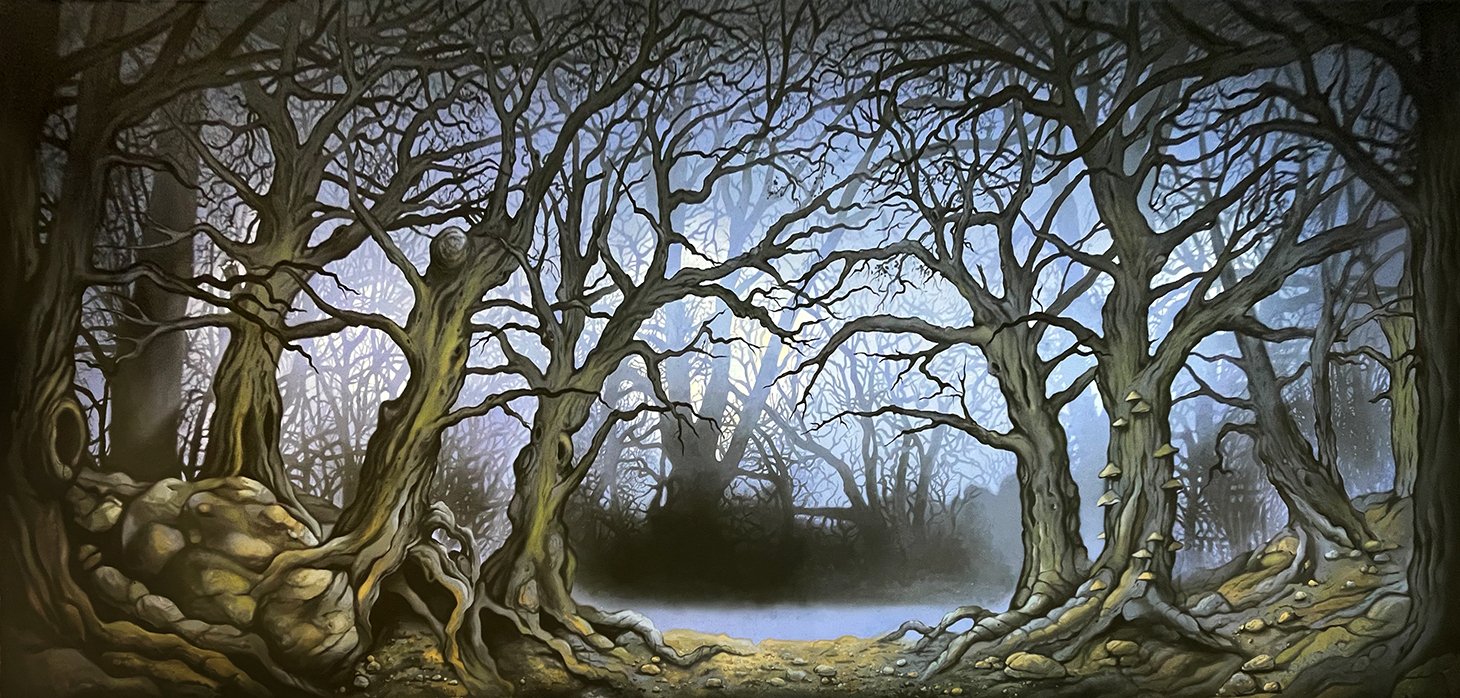
Custom Backdrops (see below)
Travelers: Black, Silver, Gold, Red, Lt. Blue, White Voile
Curtains: Black, Red, White, Silver, Blue
Cycloramas: White, Natural, Light Blue
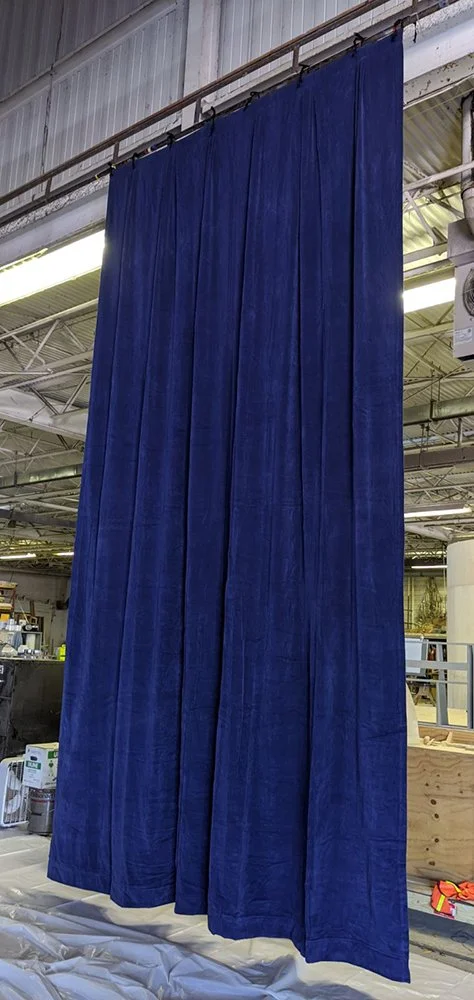
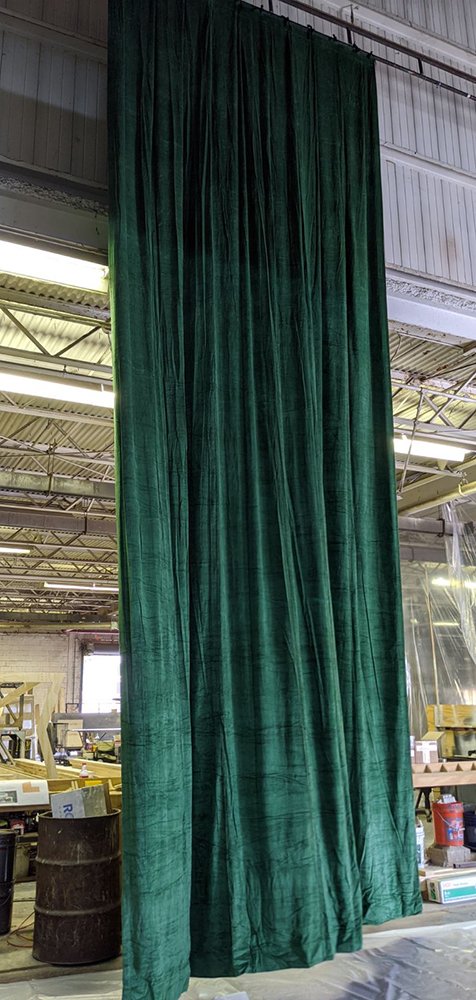
Legs: Black, Blue, Silver, Red, Gray, Purple, Green, Gold
Borders: Black
Scrims: White, Black
*click images to magnify

![Birch Tree legs 22 ft. 6 in. t x 8 ft. w [ea.]](https://images.squarespace-cdn.com/content/v1/5be0798d710699ad8d1c19c5/1745431095459-4LYQLV5H6AX8J5IZQ6EK/birch_tree_legs.jpg)

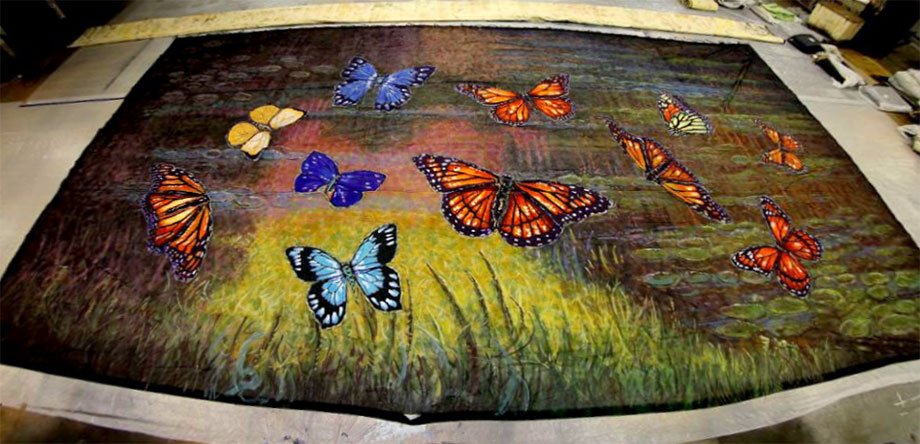
![Butterfly banner(s) 13 ft. + in. t x 12 ft. 9 in. w [ea.]](https://images.squarespace-cdn.com/content/v1/5be0798d710699ad8d1c19c5/1745436507705-G93KG5ZSIX9BRY3XWDLH/Butterfly_banners.jpg)
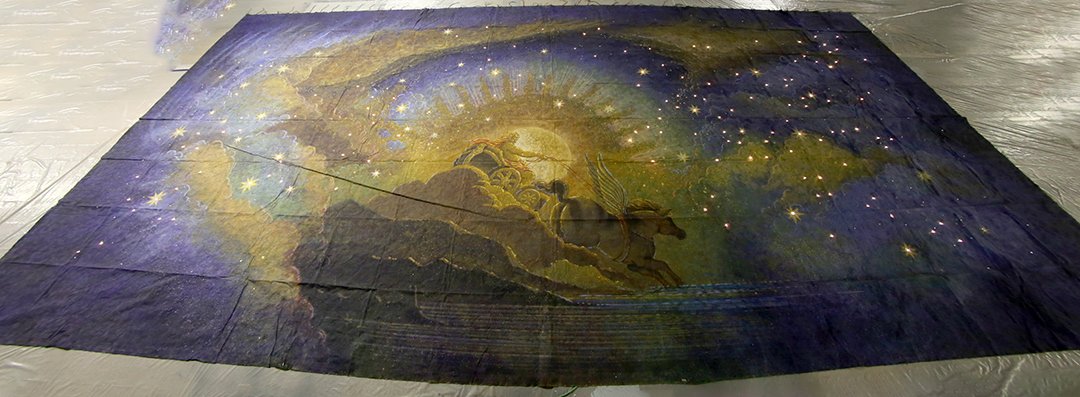







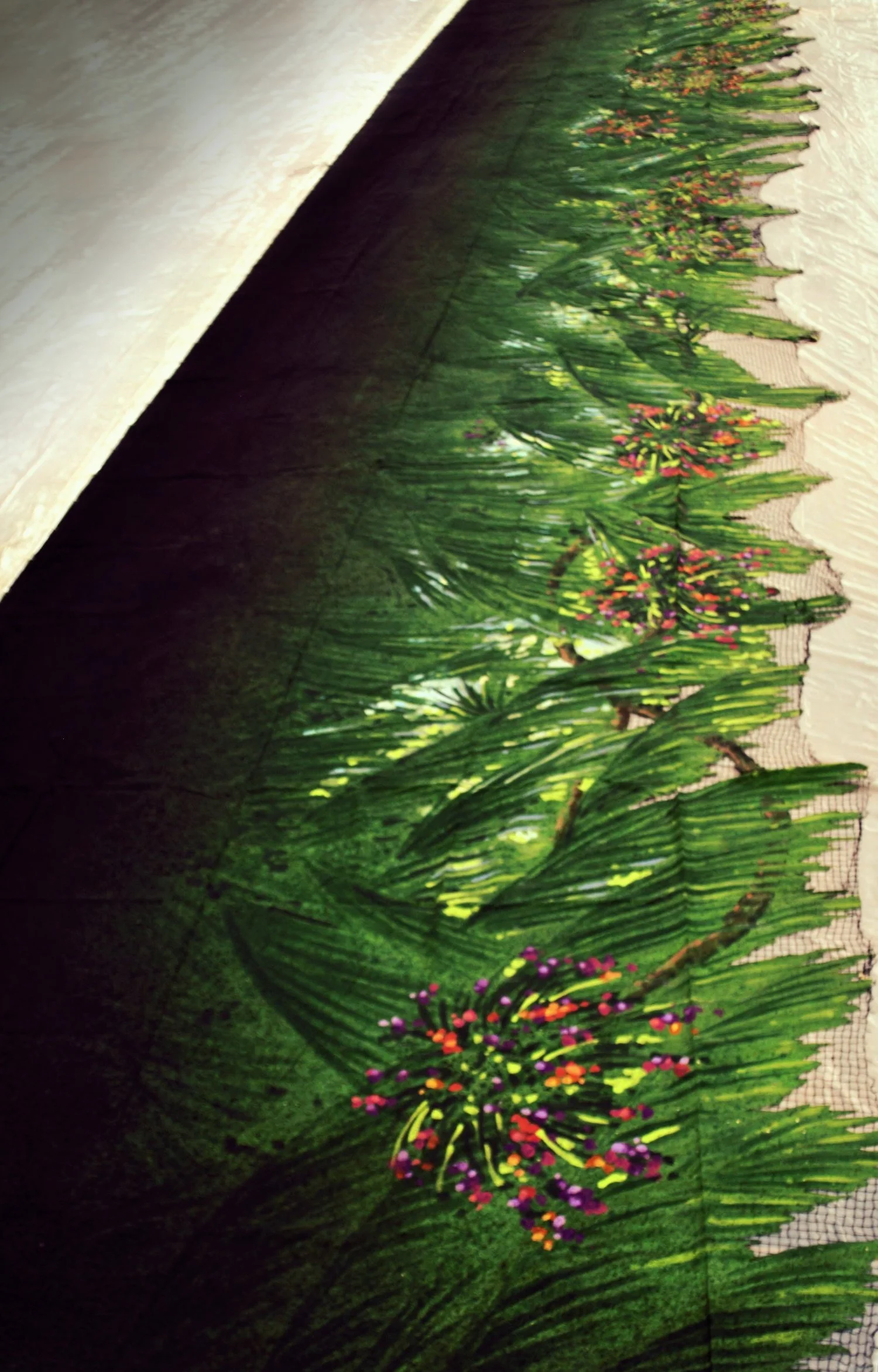

![Seahorse Dolphin backdrops 14 ft. 10 in. t x 12 ft. w [ea.]](https://images.squarespace-cdn.com/content/v1/5be0798d710699ad8d1c19c5/1745508124384-JQQNC7VEEYKPRLRKHU4Y/Seahorse_Dolphin_backdrops.jpg)


![Underwater scrims 26 ft. 9.5 in. t x 12 ft. w [ea.]](https://images.squarespace-cdn.com/content/v1/5be0798d710699ad8d1c19c5/1745506914206-32GBS4OM9SKL1ZRMVYCY/Underwater_scrims.jpg)


![Amputrees legs 29 ft. t x 14 ft. 5 in. t [ea.]](https://images.squarespace-cdn.com/content/v1/5be0798d710699ad8d1c19c5/1745508733231-Q2VAHWVKRO0LXK38Q43E/Amputrees_-legs.jpg)
Curtains, Travelers, Borders, and Legs
Curtains, travelers, borders, and legs are not merely functional components of stagecraft but are integral to the visual grammar of theatrical storytelling. These soft goods shape the stage space, guide audience perception, and support the illusion central to live performance.
1. Curtains
In general usage, “curtain” refers to any large fabric panel used on stage, but in theatre, it often denotes the grand drape (house curtain)—the ornate, frontmost curtain that separates the stage from the audience. It traditionally opens and closes at the beginning and end of a performance. Depending on its rigging, it can fly (lift vertically) or travel (open horizontally).
2. Travelers
Travelers are a specific type of curtain that opens and closes horizontally, usually from the center out to the sides. They are typically hung on tracks and can be operated manually or with a motor. Travelers are used upstage of the main curtain to divide the stage into sections, mask scene changes, or reveal new environments. A "mid-stage traveler," for instance, offers the director a means of reducing the visible playing space for more intimate scenes.
3. Borders
Borders are short, wide curtains that hang horizontally above the stage, usually in conjunction with legs. Their main function is to mask overhead rigging, lighting instruments, and fly-space machinery from the audience’s view. Visually, they help frame the vertical dimension of the stage, maintaining the illusion of a seamless, immersive environment.
4. Legs
Legs are tall, narrow curtains that hang vertically on the sides of the stage. They serve to mask the wings, allowing actors, props, and crew to move unseen. In tandem with borders, they form a masking system that creates a visual “proscenium within the proscenium,” allowing for various levels of depth, concealment, and revelation.
Together, these elements enable flexible staging, dynamic reveals, and the concealment of offstage activity—all of which are essential to both the practical and poetic dimensions of theatrical production.


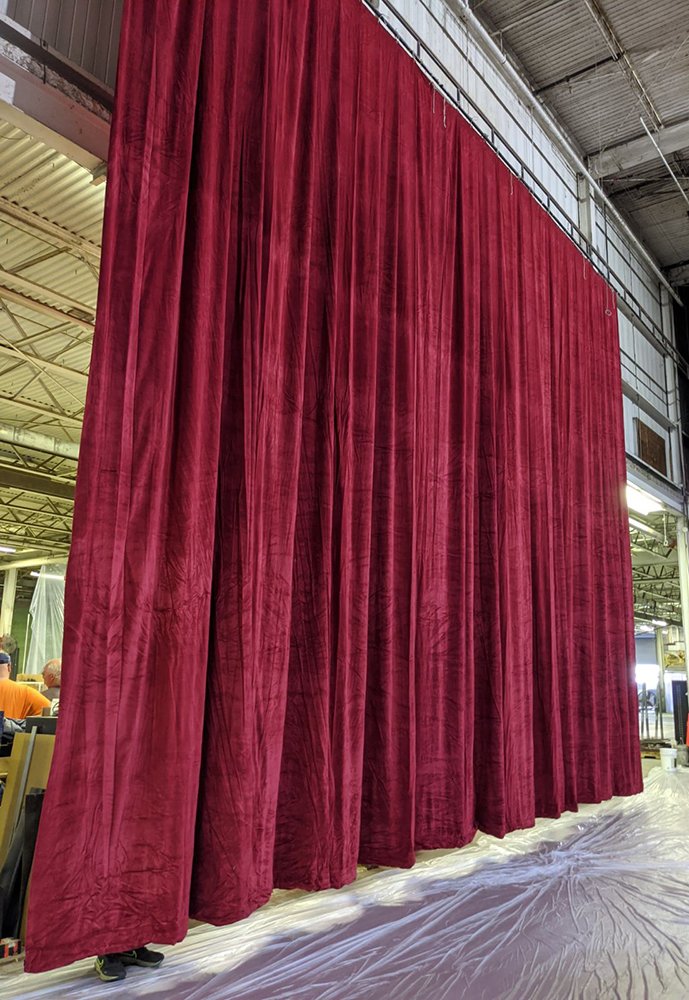
Cycloramas, Scrims, and Kabukis
Specialized soft goods used in theatrical productions to enhance visual storytelling, light design, and scene transitions. Each serves a distinct function, often in relation to lighting and transformation of stage space.
1. Cyclorama (or "cyc") - A cyclorama is a large, seamless, often white or light blue fabric panel that spans the upstage wall of the theatre. It’s used primarily to create the illusion of sky, infinite space, or abstract backgrounds when lit appropriately.
2. Scrim - A scrim is a lightweight, gauze-like fabric that can appear either opaque or transparent, depending on how it's lit.
This duality makes scrims powerful tools for theatrical illusion and visual layering.
3. Kabuki Drop - A kabuki (or kabuki drop) is a special effect curtain rigged to fall away instantly, revealing a scene, set, or performer behind it.
Each of these soft goods represents a fusion of technical mastery and aesthetic purpose, underscoring how fabric in theatre serves not just to cover or mask, but to reveal, transform, and evoke.


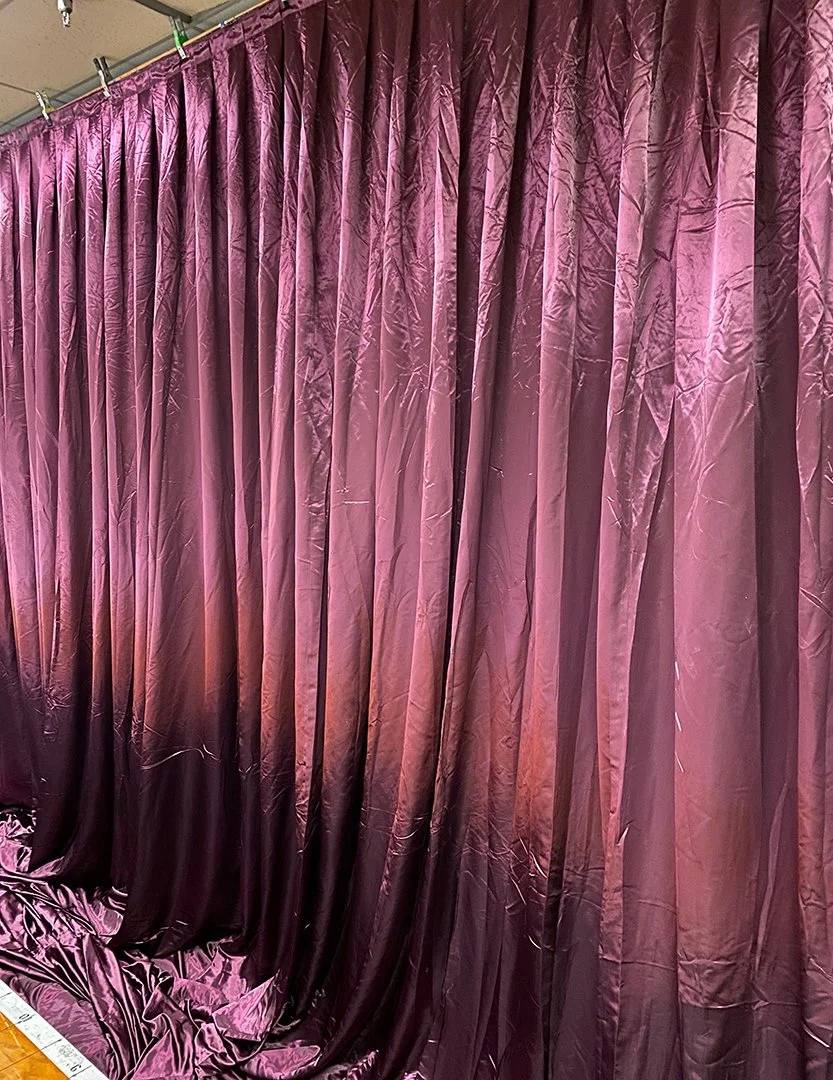

Mylar Curtains
A Mylar curtain is a type of theatrical or event curtain made from Mylar, a thin, reflective polyester film. Unlike traditional fabric drapes, Mylar curtains are shiny, lightweight, and metallic-looking, often used for special effects, dance, concerts, and stylized productions.
Uses in Theatre:
As backdrops for musical numbers or comedic sketches
To evoke a sense of glamour, fantasy, or artificiality
As moving curtains to reflect lighting effects or wind machines
In essence, Mylar curtains are more about visual spectacle than utility, adding flair and kinetic energy to performances.

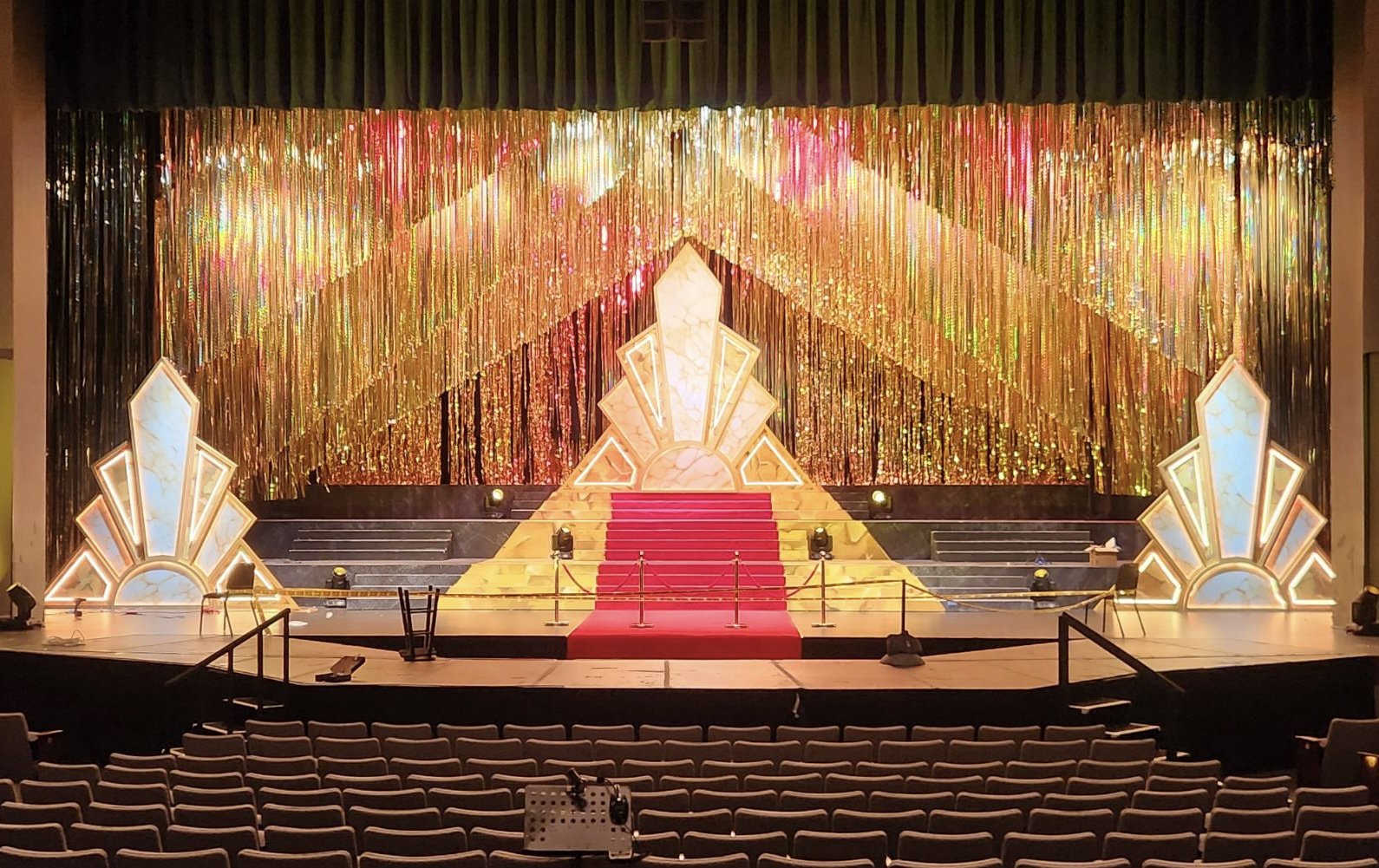
Pipe & Drape (Sleeve Masking and Deck Skirting)
Create room dividers, backdrops, booths and curtain walls.
Sizes: From 3 ft. to 20 ft. tall, From 3 ft. to 14 ft. wide. Available Colors: Black, Blue, Burgundy, Gold, Grey, Ivory, Red, Silver, White. Contact us for fabric types or for more information.

Swags and Jabots
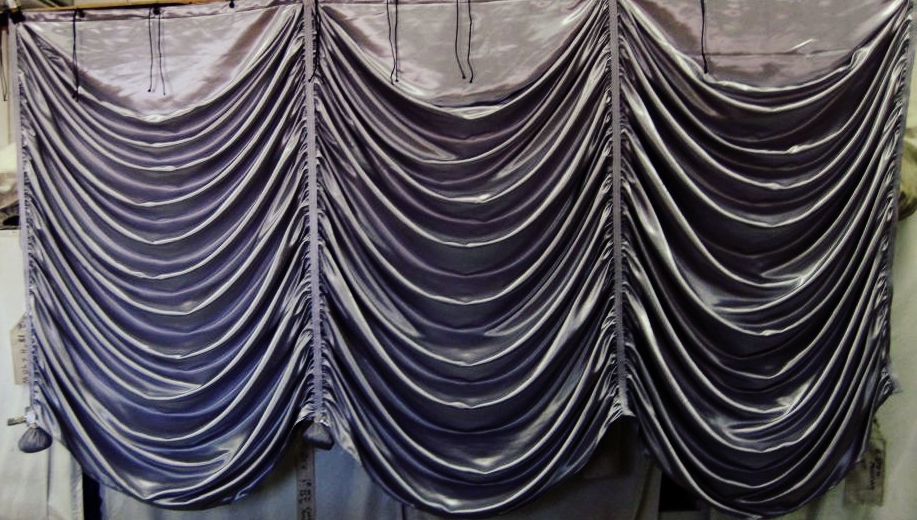
In theatre—and more broadly in drapery and design—swags and jabots are decorative fabric elements, often associated with formal or grand drapery treatments, such as the main curtain (grand drape) or decorative proscenium valances.
A swag is a semi-circular, draped section of fabric that hangs gracefully in a curve between two points. Think of it as a soft, suspended loop that creates an elegant, scalloped look.
Jabots (sometimes called cascade jabots) are the vertical, pleated or layered fabric pieces that hang down at the sides of swags.